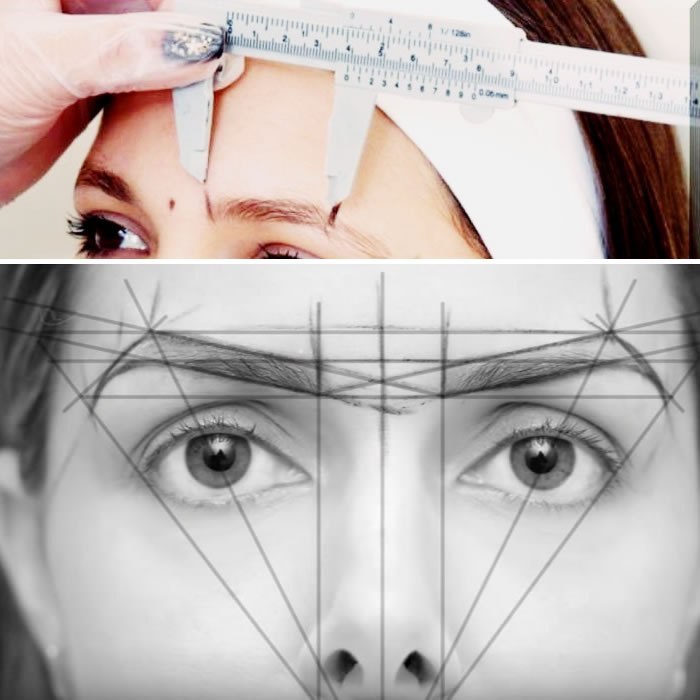
By Diamond Crown & Brow www.diamondcb.com

What is Microblading?
Microblading is a form of semi-Permanent Makeup. It uses a tattoo blade (made up of a row of pins/ needles) to manual insert the pigment colorants. When done correctly microblading will leave a beautiful hair-like appearance to each stroke. Originated in Asia and has become very popular in the last few years all across the world.
What must I know about Microblading before I commit?
Before you commit yourself to Microblading you must know the following:
- Equipment Being used; such as the Blades and Ink
- How to choose Your Skin tone; from light skin to dark skin
- Cost
- Health Factors to consider
- Differences between Skin types; from Oily to dry skin, Young vs Mature skin, Male vs Female skin
- How to take care of them after the procedure?
- Does it hurt?
- How long does it last?
- Whats the length of the Healing Process?
- What are touch ups?
Equipment used:
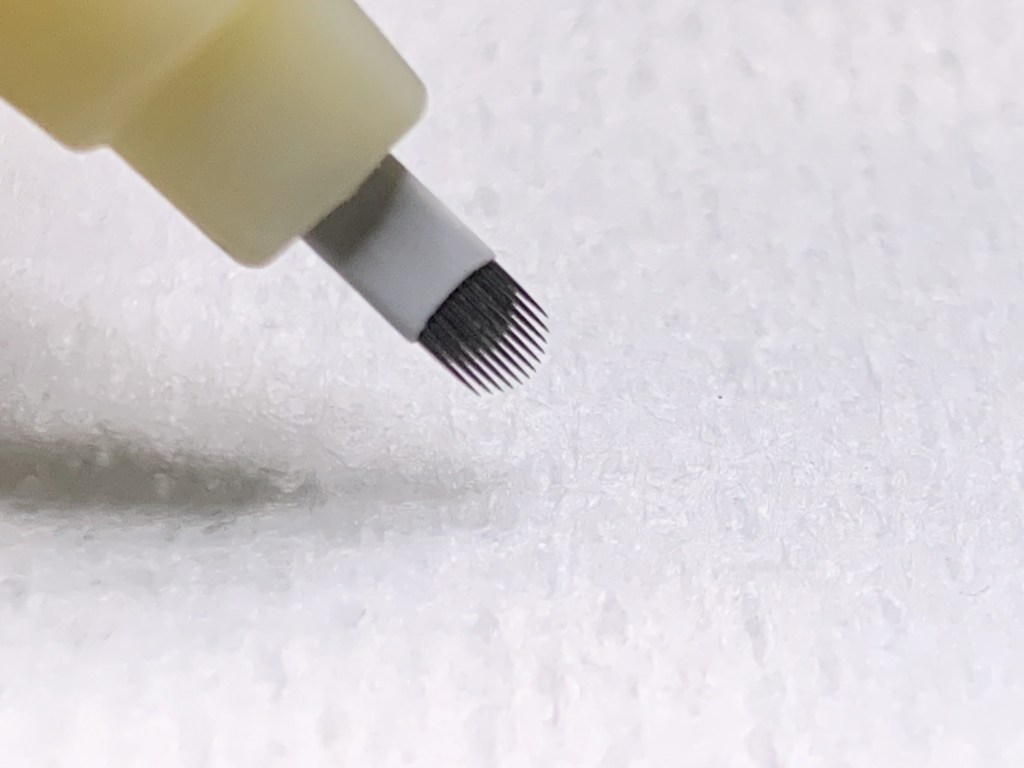
Microblades
Microblades are actually more of a row of needles or pins. The more pins or the less pins make a big difference as well as the diameter will make things go smoothly or disastrous.
Pigments and Ink Color
A major factor to Microblading and Scalp Micro Pigmentation is pigment choice. In order to do this correctly, you need to understand the fundamentals of color and undertones.
When performing SMP or Microblading, the pigment will interact with the skin’s existing pigments, which can alter the final color of the SMU.
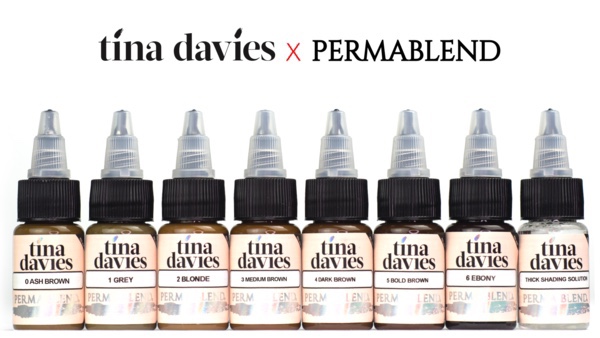
Pigments can be a combination of the two; organic andinorganic. Whether pigments are organic or inorganic, they are still likely to be synthetic.
PIGMENTS–ORGANIC & INORGANIC
Organic Pigments–This pigment is not made from living organisms, despite the name organic. Organic pigments are brighter, but less opaque, and more intense.
However, they are less stable and prone to fading. These substances are synthesized in labs, but are molecularly identical to materials that do not occur in living organisms.
The drawbacks of these pigments are that they are water-soluble. Once organic pigments enter the skin, they are quickly dissolved and will fade rather quickly.
To prevent fading, the pigments are coated with a heavier often metallic-based material, such as alumina. Coating will prevent allergic reactions in most cases because the coating isolates the pigment beneath the skin’s surface. Even after this the life expectancy of organic pigments is much less than that of inorganic pigments, therefore organic pigments are not often used.
In-Organic Pigments–This pigment is derived from laboratory synthesized ores. (An ore is a type of rock that contains sufficient minerals with important elements, including metals, that can be economically extracted from the rock). These pigments are less intense but have a longer life in the skin than organic pigments. Inorganic pigments have more opacity.
In microblading, inorganic pigments comprise the majority of the color pallet, mostly iron oxide.
The pigments used are all non-toxic, stable, and insoluble. They are often manufactured in a powder form that is constituted into a liquid with the additionof isopropyl alcohol, glycerin, distilled water and sometimes other botanicals.
The result is liquid pigment that is antiseptic, meaning it won’t cause infection.
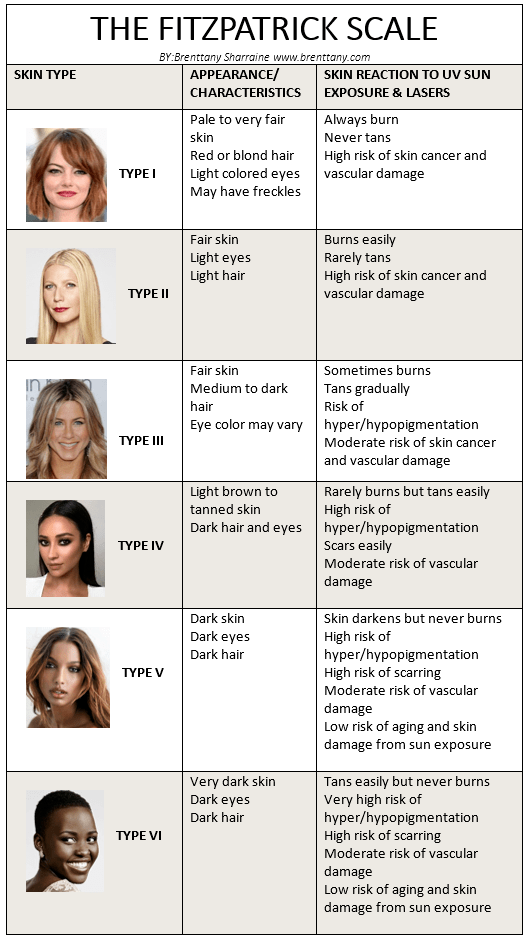
SKIN Color Scale
Its always important to know what type of skin color you have. Take a look at the Fitzpatrick Scale and see which color are you.
Cost:
Microblading can range from $250-550. Most artist and technicians cost depending on their skill level. But there are so many Specials and promotions to allure new clients. Its always to look up the area you are in for the Average Cost.
Usually the Artist or Technician charges by sessions or touch ups.
First Session and second included can cost up $250-350.
Touch ups can cost from $100-200
Health Factors to Consider
Non-Candidates:
- Pregnancy or nursing
- Diabetic patients
- Skin diseases
- Directly after Botox treatment (after 2 weeks is allowed)
- Use of Accutane, Isoltretinoin, or other retinoids (after 6 months is allowed)
- If you have a pacemaker, this manual method can be used, but any machine use is not allowed.
- Very sensitive and pain intolerant
- Sunburn or frostbitten (allowed after symptoms are gone)
- Seborrhea Dermatitis
- Very dry or peeling skin
- Excessive sebum, oily skin
- Problem skin broken capillaries
- Acne
- Moles
- Keratosis
- Very dry or peeling skin
- Problem skin
- Some previous brow work
Hazards of Microblading:
- Infection: Infection is very unusual. The areas treated must be kept clean, and only freshly cleaned hands should touch the areas. See Aftercare sheet for instructions on care.
- Uneven Pigmentation: This can result from poor healing, infection, bleeding, or many other causes. Your follow-up appointment will likely correct any uneven appearance.
- Asymmetry: Every effort will be made to avoid asymmetry, but most faces are not symmetrical so adjustments may be needed during the follow-up session to address any unevenness.
- Excessive Swelling or Bruising: Some people bruise or swell more than others. Ice packs may help reduce the swelling. The swelling or bruising typically disappears in 1-5 days. Most people don’t bruise or swell at all.
- Anesthetics: Topical anesthetics are used to numb the area to be tattooed. Lidocaine, Prilocaine, Benzocaine, Tetracaine, and/or Epinephrine cream and/or liquid are used. If you are allergic to any of these, please inform me now.
- MRI: Because pigments used in Permanent Cosmetic procedures contain inert oxides, a low level magnet may be required if you need to be scanned by an MRI machine. You must inform your MRI Technician of any tattoos or permanent cosmetics.
SKIN Types:
Oily skin, Dry flaky skin, Skin age and Male vs Female.
Oily Skin
Oily skin has more visible pores (larger). There is a visible shine, and sometimes a dull looking complexion (black and white heads may be present).
Sebum-is the light yellow oily substance that is secreted by the sebaceous gland that help keep the skin and hair moisturized. Made up of triglycerides, fatty acids, wax esters, squalene, cholesterol esters and cholesterol.
Acne
Do NOT microblade over a breakout or anything that looks like a pustule or papule.
***We treat the skin with an anesthetic wipe or blotting paper to eliminate any visible oil from the brow area. This allows for the Pigment to be absorbed more effectively. We might need to go over a hair stroke up to three times to make sure the pigment embeds in the epidermis correctly.
Dry Skin
With this skin type, there are almost invisible pores. The complexion will be dull, rough and flaky. Dry skin can have red patches, less elasticity and more visible lines.
Sensitivity is common with this type of skin and the client could sensitive during microblading. Because dry skin is lacking moisture, the pigment absorbs very quickly so each stroke would only need to be done 1-2 times.
Sometimes the pigment will fade quicker if flaking is present.
Age Factors between Young Vs Mature Skin
Mature Skin–
The pigment in those with mature skin tend to last much longer than the average. The main reason is the skin cells take longer to regenerate. The pigment won’t leave the epidermis as fast.
Cell turnover on a middle-aged person is 30-40 days, and mature skin slows down to 45-90 days.
The downside is the skin is normally thinner, so the collagen and elastin breakdown quicker, which means the skin is thinner; therefore, you have to use a lighter pressure.
Young Skin
Ages 25 and under. Skin regenerates much faster and the cell turnover rate is 14-28 days. Remember, it is important to blade deep enough so the strokes don’t disappear too quickly.
This client will need to come in sooner for their touch up.
Factors between Male Vs Female
Male Skin
Men’s skin is different than women due to their hormones and other factors. A man’s outer protective skin is 20% thicker than a woman’s.
It is firmer and harder, which results in better moisture retention. At any age, a man’s skin is richer in collagen than a woman’s, which results in strength and firmness.
The pressure of your blade can be slightly harder than when you blade a woman’s skin. The results will last longer on a man as well.
How does the ink stay in my eyebrow?
Microblading is done by using a unique hand instrument with a small row of very fine needles that deposit pigment into the dermis with slicing, feathering strokes.
The pigment is implanted in the basal membrane, which divides the Epidermis from the Dermis layer of the skin. This creates a very crisp, fine hair strokes that don’t blur after healing like you would experience with a traditional permanent makeup machine.
Old Eye Brow Tattoos
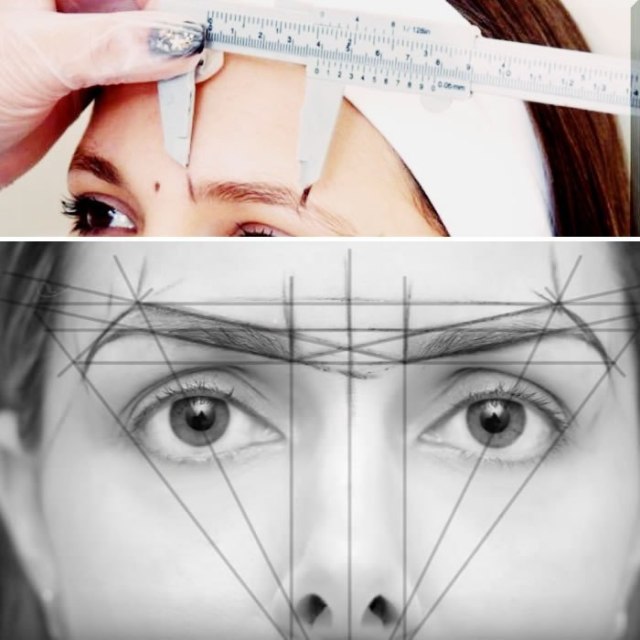
**If you have an old tattoo, note that microblading will NOT fully cover your tattoo. It will still likely be visible through the microblading strokes.
Only another “blocky” procedure, like a brow tattoo, may cover what you already have. Due to the process that microblading is, tattoos are unable to be fully covered. Previously tattooed clients likely require more than 2 sessions. This can occur because of the built up scar tissue in the brow area from the tattoo.
If you would like more than 2 sessions, a fee will be assessed. We do our best to cover the existing tattoo and color match but again, due to previous work on the skin, the result will not always be ideal.
What do I do for After Care?
Days after the Procedure
Day 1
-Mild swelling, itching, light scabbing, slight bruising and dry tightness. Aftercare balm is nice for scabbing and tightness.
Day 2 -7
-Too dark and slightly uneven appearance. After 2-7 days the darkness will fade and once swelling dissipates unevenness usually disappears. If they are too dark or still a bit uneven after 5 weeks then we will make adjustments during the touch up appointment.
Day 7-14
-Color change or color loss. As the procedure area heals, the color will lighten and sometimes seem to disappear. This can all be addressed during the touch up appointment and is why the touch up is necessary. The procedure area has to be completely healed before we can address any concerns. This takes about five weeks.
Does it hurt?
There is a mild discomfort. Once the procedure is completed the eye brow can feel like slight paper cuts on your eyebrows. This is designed to be a gentle procedure with minimal discomfort.
The degree of discomfort will depend on several factors, such as if you opt for anesthetics, location of the treatment, and your pain threshold. In the beginning you will feel a scratching feeling while we are marking the shape and design of the brow.
A numbing cream is then applied which is absorbed into the skin within a few seconds. Once the cream has absorbed, you will have very little feeling.
How long does it last?
Everyone is different; it can last 1+ years. We suggest Yearly touch ups, however some clients require an every 6-9 month touch-up. Due to the face wash, age group and type of skin will determine how long it will last.
Usually the younger you are the more often you will need to do a touch up that’s because your cells are constantly changing as we get older. The older will require less touch ups because the skin isn’t changing as quickly. Oily skin plays a factor too.
The oilier the skin the faster it will fade and or sometimes doesn’t take the pigment colorant as well compared to less oily skin. Face wash with exfoliates can also fade the ink..
Healing Process and Touch-Up:
- If you keep your brows clean and dry, only a thin film (not a scab) will appear after 4-7 days. It will peel off itself in 7-10 days (do NOT peel it off). After the film peels off you can still feel some dryness, in this case clean or disinfect the area with a small amount of coconut or grapeseed oil. Be careful with any cleaning in the affected area. The full healing period is 28-45 days.
- If there is any contact with water, sebum or sweat, the wound will expand and cause a scab. The scab will result in itching and peeling of the pigment. If you scratch the scab, a scar or white spot can appear and no pigment will be left.
Touch Ups
Needing a touch up months or years later.
A touch up may be needed 6 months to 2 years after the touch up procedure depending on your skin, products you use on your skin, medications, sun exposure, etc.
The Touch Ups must be scheduled 5-10 weeks after the first session and every 6 months to 2 years to keep them looking fresh and beautiful. There will be a charge for any touch up sessions after 10 weeks.
**Failure to follow after care instructions may result in infections, pigment loss or discoloration. Everyone’s skin heals differently. It is important to remember that this is a two-part process and the second touch-up will complete the procedure.
The touch-ups is recommended between 5-10 weeks. Not everyone, but some people will need a touch-up to fill in missing hairs, make hair longer or achieve a more intensive color. After you have fully healed, you will see the finished result.
AfterCare Instructions
After care is very important in order to achieve a beautiful and lasting results.
- Water or any other liquids cannot come in contact with the affected area for 14 days after microblading, even a small drop will expand a wound and a scab will appear.
- Apply a thin layer of the given “Aftercare Balm” as directed. If your skin is oily make sure you keep your brows clean and dry. If your skin is dry, you can apply the balm more times if needed.
- If itching occurs, you can use Bactine, and it will also disinfect the area. Bactine contains lidocaine and benzalkonium chloride.
- After 14 days, as long as the brows are no longer scabbing, you can use a gentle soap or non-greasy cleaner to keep your brows clean.
- Do not use any other ointments, or creams with vitamins or antibiotics on brows.
- No sunbathing, or tanning for 4 weeks.
- No chemical peels, mesotherapy, dermabrasion, Botox or any other intense treatments for 4 weeks.
- Do not use any makeup on affected area for 2 weeks.
- Do not scratch, touch or sleep on your brows for at least 2 weeks.
- No heavy workouts for 10-14 days. Avoid sweating.
- Sometimes residual pigment, blood, white blood cells, etc., can arise from the open wound, if this occurs you should gently dab this away. Don’t panic if dry patches or scabs appear as this can be taken care of in the second touch-up appointment.
- Avoid Petroleum Jelly or Vaseline during your healing period. Anything with a petroleum base can cause a reaction, crusting, scabbing and sweating so the skin is not able to breathe.
For a Free Consultation go to www.diamondcb.com or click on Diamond Crown & Brow
 Local Loyal Clients' Blogs